
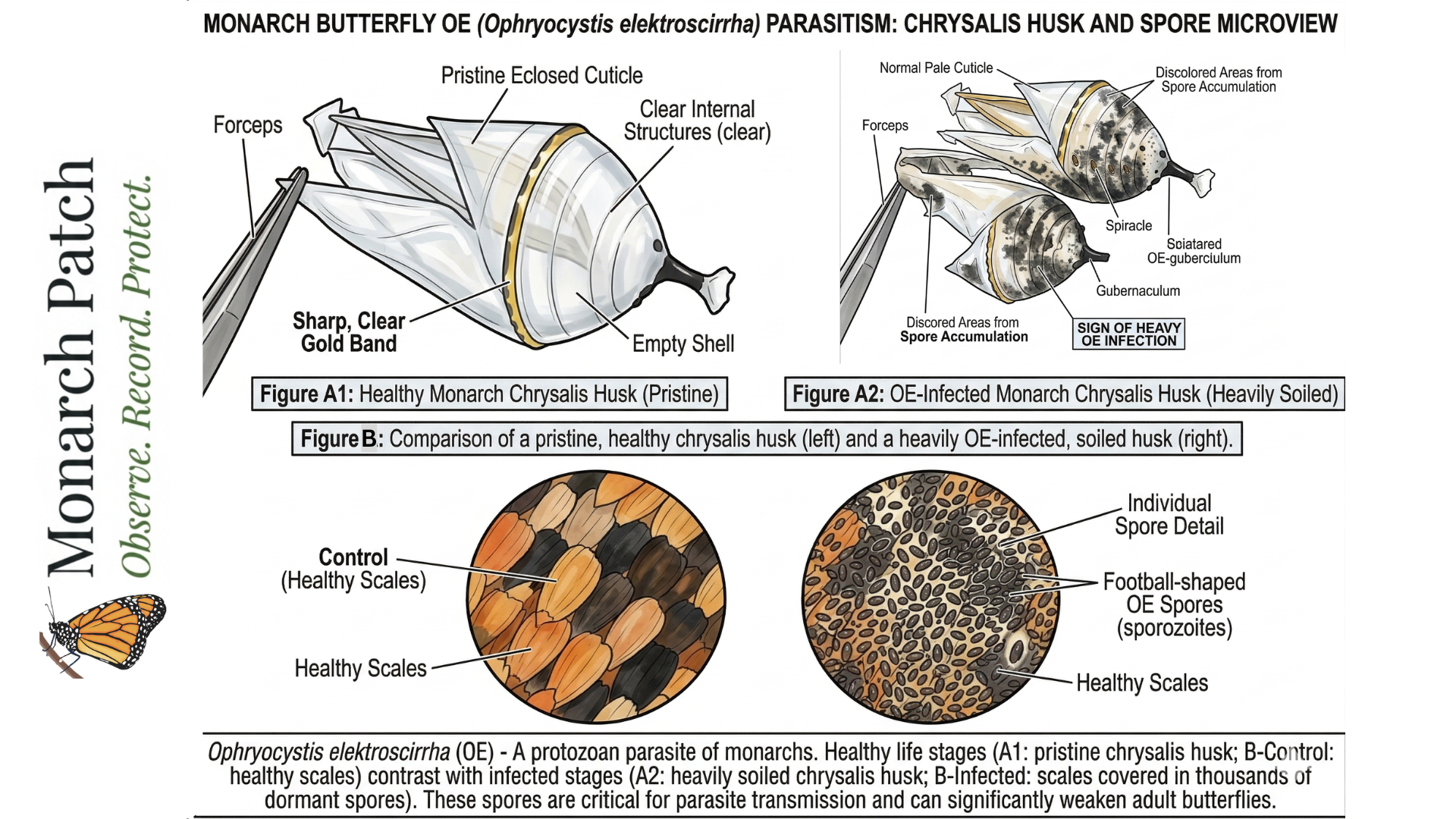
If you raise monarchs, you’ve probably heard of Ophryocystis elektroscirrha, better known simply as OE. This protozoan parasite infects monarch butterflies, weakening adults and spreading from one generation to the next through dormant spores shed onto milkweed leaves. Testing for OE matters because heavily infected butterflies may struggle to fly, fail to migrate, or die prematurely. Every infected adult that goes untested can silently contaminate your milkweed patch for the caterpillars that follow.
The Problem with the Standard Test
The go-to method for OE detection is the abdomen sticker test: you press a small piece of clear tape against a butterfly’s abdomen, then examine the tape under a microscope for the telltale football-shaped spores. It works, but it comes with a real downside. You have to handle the butterfly. Anyone who has tried this knows how stressful it can be, both for you and for the monarch. Grabbing a freshly eclosed butterfly risks breaking delicate tarsi (the tiny claws at the ends of their legs), damaging scales, or injuring wings. That kind of heartbreak is enough to make most hobbyists skip testing altogether.
A Better Way: Just Look at the Chrysalis Husk
Here’s the good news. Monarch enthusiasts have observed a simple, no-contact visual method that appears to reliably indicate OE infection, and it requires zero butterfly handling.
After a monarch ecloses, take a close look at the empty chrysalis husk. A healthy husk is clear or pale, with a sharp gold band and a clean, translucent cuticle. An OE-contaminated husk, by contrast, looks visibly dirty, especially around the ringed folds near the top. Those dark, sooty-looking deposits are masses of OE spores that were trapped on the interior surface as the butterfly emerged.
This observation has been reported and compared against traditional sticker tests by multiple monarch enthusiasts, and the visual results corresponded closely to the microscope-confirmed sticker results. Clean-looking husks matched clean sticker tests. Lightly dirty husks matched light spore loads. And heavily soiled husks matched heavy infections.
Confirm It Under a Microscope
Want to be sure? You can examine a suspect husk under a basic microscope. The OE spores are distinctive: tiny, dark, football-shaped (ellipsoid) spheres, scattered individually or clumped in dense deposits on the husk’s inner surface. They’re unmistakable once you know what to look for.
You don’t need expensive lab equipment. A portable pocket microscope like the Carson MicroMini MM-300 (available on Amazon for around $50, affiliate link) does the job perfectly. It’s compact, affordable, and powerful enough to clearly resolve individual OE spores.
What Does the Science Say?
While the chrysalis husk test itself has not yet been formally validated in a peer-reviewed study, the underlying biology that makes it work is well established in the scientific literature. Researchers have known since the original 1970 description of OE that the parasite completes its development in the hypodermal tissue, the layer between the developing butterfly and the chrysalis shell (McLaughlin & Myers, 1970). Spores form in this space during the final days of pupation, and the emerging butterfly carries them on its exterior (Altizer & Oberhauser, 1999). Researchers at the University of Georgia routinely look for visible signs of OE infection on the pupa before eclosure as a first-pass screen, then confirm with the tape method afterward (Majewska et al., 2017). The Monarch Joint Venture and Project Monarch Health both note that heavy infections can produce visible dark spots through the chrysalis skin before the butterfly even emerges. In short, the science confirms that OE spores accumulate right where the chrysalis interior meets the developing butterfly. It makes complete biological sense that those spores would be left behind on the husk after eclosure, which is exactly what enthusiasts are observing. This method deserves further formal study, but the evidence so far is very encouraging.
Track Your Findings with Monarch Patch
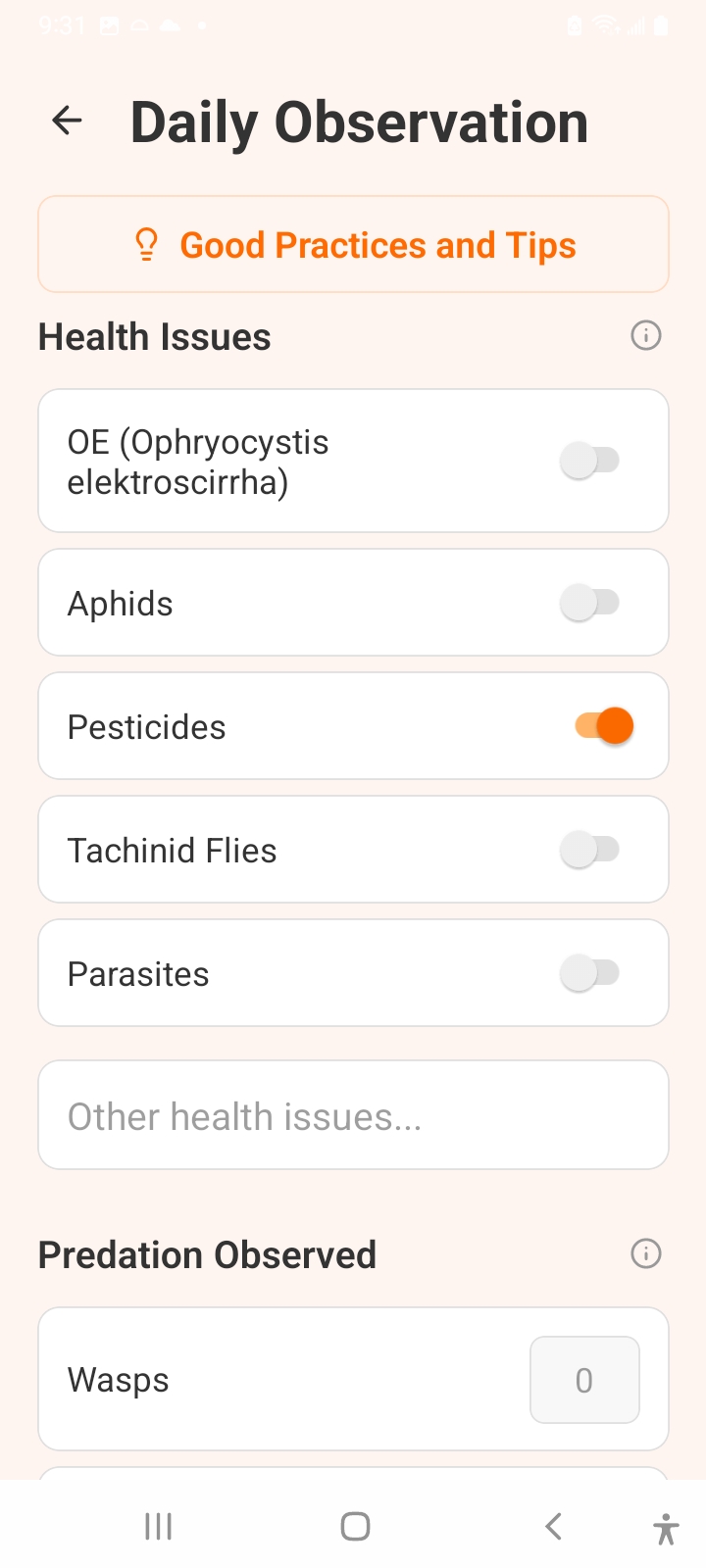
Once you start checking husks, you’ll want a simple way to log what you find. The Monarch Patch app makes this easy. Its Daily Observation form includes a dedicated OE toggle right under Health Issues, so you can record OE detections alongside other observations like aphids, tachinid flies, and predation events. Over time, this helps you spot trends in your garden, like OE prevalence climbing later in the season, and contributes to a broader picture of monarch health.
Why This Matters
This visual husk test is a game-changer for backyard monarch programs. You can assess every single chrysalis in your enclosure after the butterfly has already emerged. No grabbing, no pinching, no broken claws. So next season, don’t toss those empty husks. Line them up, take a close look, and keep your monarchs and your data in good shape.
References
- McLaughlin, R.E. & Myers, J. (1970). Ophryocystis elektroscirrha sp. n., a Neogregarine Pathogen of the Monarch Butterfly Danaus plexippus (L.) and the Florida Queen Butterfly D. gilippus berenice Cramer. Journal of Protozoology, 17(2), 300-305. doi:10.1111/j.1550-7408.1970.tb02375.x
- Altizer, S.M. & Oberhauser, K.S. (1999). Effects of the Protozoan Parasite Ophryocystis elektroscirrha on the Fitness of Monarch Butterflies (Danaus plexippus). Journal of Invertebrate Pathology, 74(1), 76-88.
- Altizer, S.M., Oberhauser, K.S. & Brower, L.P. (2000). Associations between Host Migration and the Prevalence of a Protozoan Parasite in Natural Populations of Adult Monarch Butterflies. Ecological Entomology, 25(2), 125-139.
- Davis, A.K. & Howard, E. (2004). A Non-destructive, Automated Method of Counting Spores of Ophryocystis elektroscirrha in Infected Monarch Butterflies. Florida Entomologist, 87(2), 231-234. BioOne link
- Majewska, A.A., Satterfield, D.A., Harrison, R.B., Altizer, S. & Davis, A.K. (2017). Environmental Persistence Influences Infection Dynamics for a Butterfly Pathogen. PLOS ONE, 12(1), e0169982. PMC link
- Sander Lower, S., Altizer, S., de Roode, J.C. & Davis, A.K. (2013). Genetic Factors and Host Traits Predict Spore Morphology for a Butterfly Pathogen. Insects, 4(3), 447-462. PubMed link
- Project Monarch Health, University of Georgia. “What is OE?” monarchparasites.org/oe
- Monarch Joint Venture. “Monarch Disease.” monarchjointventure.org